Legal Research and Writing: Ted Tjaden
Home
Books
Law Journals
CLE Papers
Encyclopedias
Case Digests
Reference Tools
Law Blogs | News
Case Law | Court
Dockets
Legislation
International
Law
Foreign Law
Governments
Organizations
Knowledge
Management
Legal
Research and AI
Legal Writing
Legal Citation
Teaching LRW
Law-Related Movies
Law-Related Movies — Courtroom Dramas
Movies - Home Page
"A to Z" List of Law-Related Movies
Movies Organized by Substantive Law Subject
Comedies
Court Martial Movies
Courtroom Dramas
Documentaries
Inspirational Lawyer Movies
Prison-Related Movies
Top 10
12 Angry Men (1957). Starring Henry Fonda and others. Directed by Sidney Lumet. A well done drama that takes place in the jury deliberation room where a jury must decide the fate of a young man accused of murdering his father. The case seems open and shut until the jury begins to deliberate. Read Roger Ebert's 4 out of 4 stars review here. There is also a 1997 remake directed by William Friedkin and starring Jack Lemmon. The Simpsons take on this movie (with Homer being the lone holdout juror) is from Season 5 (The Boy Who Knew Too Much).
The Accused (1988). Starring: Kelly McGillis, Jody Foster. Courtroom drama involving rape victim Sarah Tobias (played by Jody Foster) who at times seems to be the one on trial. Read Roger Ebert's review (3 stars).
Adam's Rib (1949). Starring: Spencer Tracy, Katherine Hepburn. A courtroom drama/comedy where Katherine Hepburn and Spencer Tracy, as husband and wife, are on opposite ends of a criminal prosecution where she defends a women charged with murdering her husband with Spencer Tracy prosecuting the case. Conflict of interest? Read a movie review by Tim Dirks.
Amistad (1997): A historical drama, directed by Stephen Spielberg, that tells the true story of African slaves who mutiny against their capture and transport aboard La Amistad, a slave ship. Focusing largely on the courtroom scenes in which the slaves are charged with mutiny, the story ends in a decision from the US Supreme Court ruling that the slaves were wrongfully kidnapped and in their rights to mutiny and ordered them freed (realize this summary does not do justice to the movie or the story). Read Roger Eb
Anatomy of a Murder (1959). Starring Jimmy Stewart, Lee Remick, Ben Gazzara, directed by Otto Preminger. A courtroom drama involving a murder trial where the accused, a lieutenant in the army, is charged with murdering a bar owner who had raped his wife. Will the defence of temporary insanity prevail? Multiple Academy Award nominations. Read an online review from the New York Times.
And Justice for All (1979). Starring Al Pacino, directed by Norman Jewison (a University of Toronto graduate). Al Pacino defends a judge who is charged with rape, a judge with whom he has had run-ins in the past. A good examination of the justice system, corruption and legal ethics. Read Roger Ebert's review (3 stars).
Better Call Saul (series) (2015-current). Created by Vince Gilligan and Peter Gould and starring Bob Odenkirk as lawyer Jimmy McGill/Saul Goodman. This multi-season TV drama/prequel to Breaking Bad tells the origin story of Jimmy McGill and his transformation into Saul Goodman. Strong story lines about his relationship with his older, brilliant attorney brother Chuck McGill (played by Michael McKean) and his law partner Kim Wexler (played by Rhea Seehorn). Highly entertaining.
Beyond a Reasonable Doubt (2009). Starring Michael Douglas, Jesse Metcalfe, and Amber Tamblyn. An extremely implausible story (and Hollywood remake of a better 1956 version). It tells the story of a journalist who suspects that the publicity-seeking District Attorney (played by Michael Douglas) has too good of a conviction rate and might be causing evidence to be planted at crime scenes. What the journalist does next is stupid (in allowing himself to be framed for murder in order to see if the D.A. will plant evidence against him). Stereotypical courtroom scenes with a "You better be going somewhere counsellor" judge. Read the Rotten Tomatoes reviews here.
Billy Budd (1962). Starring Peter Ustinov, Terence Stamp. The story, based on Melville's novel, of Billy Budd, accused of mutiny on the high seas of the murder of the ship's Master-of-Arms. Read the original New York Times review here.
Body of Evidence (1993). Starring Madonna, Willem Dafoe, Joe Mantegna, Anne Archer, and one of Julianne Moore's earlier movie roles. A fairly implausible story of an accused (play by Madonna) charged with murdering a wealthy old man for his money (through sex). Joe Mantegna plays the prosecutor; Willem Dafoe plays her lawyer. Many stereotypical courtroom scenes. See the original New York Times review here.
Breaker Morant (1980). Starring Edward Woodward, Jack Thompson. An excellent Australian court-martial movie set in the time of the Boer War. Three Australian lieutenants are treated as scapegoats when prosecuted for executing prisoners of war. Strong performance by their defence lawyer. See a good review here from The Guardian.The Caine Mutiny (1954). Starring Humphrey Bogart, Jose Ferrer, Van Johnson, and Fred MacMurray. Based on the novel by Herman Wouk. This movie tells the story of an alleged mutiny aboard a Navy destroyer—minesweeper in the Pacific in World War II, with Humphrey Bogart playing Captain Queeg. Read the original New York Times review here. Also made into a "made for TV movie" in 1988 directed by Robert Altman and starring Eric Bogosian, Jeff Daniels and Brad Davis.
Capturing the Friedmans (2003). Directed by Andrew Jarecki. A captivating documentary of a high school teacher, his wife and their three sons and their involvement in the criminal justice system when the father and youngest son are charged with sexual crimes involving children. The movie's tagline – "Who do you believe?" – is reflected in the questions raised by the director regarding the prosecution and defence of the accused. Read Roger Ebert's online review (3.5 out of 4 stars).The Case Against 8 (2014). Director by Ben Cotner and Ryan White. This documentary tells the story of the fight to overturn California's Proposition 8 and the court battle in Perry v Schwarzenegger.
The Castle (1997). Starring Michael Caton. An extremely hilarious Australian comedy dealing with, of all things, expropriation (hence the title, which stems from the saying "A man's home is his castle"). Some hilarious courtroom scenes. Laugh-out-loud funny. See Roger Ebert's review (3 out of 4 stars).
The Central Park Five (2012). Directed by Ken Burns, Sarah Burns and David McMahon. This documentary tells the stories of five young black men who in 1989 were charged and convicted of a grisly rape in Central Park, New York, despite their claims of innocence based on what were alleged false confessions. Read Roger Ebert's online review (3.5 out of 4 stars).
The Chamber (1996). Starring Chris O'Donnell, Gene Hackman and Faye Dunaway. Based on John Grisham's novel, the story of a young lawyer who defends his racist grandfather who is on death row for murdering two Jewish boys. Read Roger Ebert's review (2 out of 4 stars).
A Civil Action (1998). Starring John Travolta, Robert Duvall. A well told story based on Jonathan Harr's book of a true story involving a class action lawsuit against environmental polluters that involves multiple ups and downs including the potential bankruptcy of the lawyer (played by John Travolta) handling the case. Read Roger Ebert's review (3.5 out of 4 stars).
Class Action (1991). Starring Gene Hackman, Mary Elizabeth Mastrantonio. An unlikely scenario where father and daughter act on opposite sides on a products liability case involving cars that explode. He is the liberal plaintiff's lawyer, representing the underdog, she is a corporate type, acting for the defendant. Read Roger Ebert's review (3 out of 4 stars).
The Client (1994). Starring Susan Sarandon and Tommy Lee Jones. Based on the John Grisham novel, tells the story of a young boy who is a witness to some Mob action and secrets and who therefore seeks out a lawyer to help protect him from the Mob and the FBI. Read Roger Ebert's review (2.5 stars out of 4).
The Conspirator (2010). Directed by Robert Redford and starring James McAvoy, Robin Wright, Kevin Kline, Evan Rachel Wood and Tom Wilkinson. James McAvoy plays the young lawyer assigned to defend Mary Surratt (played by Robin Wright), the mother of the alleged co-conspirator of John Wilkes Booth in the assassination of Abraham Lincoln, arrested for failing to provide the location of her son.
Conviction (2010). Directed by Tony Goldwyn and starring Hilary Swank and Sam Rockwell. Tells the true story of Bette Ann Waters, a single mother whose brother was (as it turns out) wrongfully convicted of murder. Her "conviction" in her brother's innocence leads to her returning to school - and eventually law school - to help overturn her brother's wrongful conviction through DNA evidence (with the help of Barry Scheck of the Innocence Project. Read Roger Ebert's review (3 out of 4 stars).A Cry in the Dark (1988). Starring Meryl Streep and Sam Neill. Based on the true story of an Australian mother who is charged for the murder of her daughter despite her claim that a dingo stole her baby from their tent. Read Roger Ebert's review (3 out of 4 stars).
Denial (2016). Directed by Mick Jackson, written by David Hare. This British courtroom drama tells the true story of American history professor, Deborah Lipstadt (played by Rachel Weisz), sued for libel in the UK by alleged Holocaust denier, David Irving (played by Timothy Spall). Tom Wilkinson and Andrew Scott play the lawyers defending Lipstadt. Although we did not realize it at the time, my wife and I saw the filming of this movie at the Royal Courts of Justice during the week of 18 January 2016 while driving by in the London 19 bus where we saw Timothy Spall being filmed on the courtroom steps. The movie has consistently had a Rotten Tomatoes rating in the 80% range since being released.
Eight Men Out (1988). Cast of many, directed by John Sayles. Tells the true story of the 1919 Chicago White Sox players who took bribes to lose the World Series. Involves court room scenes. Read Roger Ebert's review (2 out of 4 stars).
Evelyn (2002). Starring Pierce Brosnan, Julianna Margulies and Aidan Quinn and directed by Bruce Beresford. Set in Ireland in 1953, this movie tells the story of an unemployed father (played by Brosnan) who loses his children to a Church-run orphanage and his efforts to go to court to get them back. Roger Ebert's review here (3 out of 4 stars).
A Few Good Men (1992). Starring Jack Nicholson, Tom Cruise, Demi Moore, many others. Tom Cruise plays a Navy lawyer charged with the duty of defending two Marines charged with murder who say they were acting under orders of a colonel (played by Jack Nicholson). Good court room and trial prep scenes. Read Roger Ebert's review (2.5 stars out of 4).First Monday in October (1981). Starring Walter Matthau and Jill Clayburgh. A reader of SLAW noticed my list of law-related movies had initially omitted this movie (which I have not yet seen), which stars Jill Clayburgh playing the first female judge on the United States Supreme Court (which, coincidentally, was the same year that Sandra Day O'Connor sat as the first female judge on that Court). According to descriptions, Walter Matthau plays the curmudgeonly Liberal judge on the Court when supposed comedic friction ensues between the two of them. Read Janet Maslin's largely unfavourable 1981 review in The New York Times.
Fracture (2007): I saw this movie when it came out and thought it was a bit silly. It is a courtroom drama of a young prosecutor, played by Ryan Gosling, prosecuting his last murder case before jumping ship to become a plaintiff’s lawyer. The prosecution is of a wealthy businessman, played by Anthony Hopkins. It seems like an open-and-shut case, but is not. To avoid any spoiler alerts, I won’t say anything more. Read Geoff Pevere's review here.
Ghosts of Mississippi (1996): Rob Reiner directed this courtroom drama, based on a true story of the trial of a white supremacist (played by James Wood) accused of murdering civil rights activist Medgar Evers in 1963. Alec Baldwin plays the prosecutor who brings charges years after the murder with the support of Evers’s spouse, played by Whoopi Goldberg. Read Roger Ebert's review here (2.5 of 4 stars).
Goliath (series) (2016-current) (Prime Video). Created by David E. Kelley and Jonathan Shapiro and starring Billy Bob Thornton as lawyer Billy McBride. Currently available in its second season (with a different storyline in each season), the courtroom drama features a delicious portrayal of a brilliant but slightly sketchy street lawyer who was formerly a partner in a large Los Angeles law firm against whom he does battle in Season 1 in a courtroom trial about corporate coverup by a military defence contractor (with apparently no concern for the concept of conflicts of interest). Highly recommended.
Guilty as Sin (1993). Sidney Lumet directs Starring Rebecca as a female defense attorney defending Don Johnson, accused of murdering his wife. Fairly typically Hollywood portrayal of lawyers and the legal system and the ethical dilemmas facing criminal lawyers. Read Roger Ebert's 3-star review here.
I Am Sam (2001). Starring Sean Penn, Michelle Pfeiffer. A nicely told story of a child custody case involving Sean Penn, as the father, who has the mental capacity of a 7-year old. When is 7-year old daughter is taken by child welfare authorities, he hires a lawyer (played by Michelle Pfeiffer) to act on his behalf. Some good courtroom scenes. Read Roger Ebert's review (2 out of 4 stars).
I Love You, Now Die: The Commonwealth vs. Michelle Carter (2019). This two-part documentary, available on HBO, tells the story of then 17-year-old Michelle Carter who was charged with involuntary manslaughter regarding the death by suicide of her friend Conrad Roy who the authorities alleged she encouraged to commit suicide through numerous text message and phone calls.
In Cold Blood (1967). Based on Truman Capote's "fictional" re-telling of a true crime story of two drifters who brutally murder a farm family during a botched robbery. One of the criminals is played by Robert Blake, who himself was later charged (but acquitted) in the murder of his wife. Read Roger Ebert's review here.
Inherit the Wind (1960). Starring Spencer Tracy, Frederic March. Loosely based on the true story of the 1925 "Scopes monkey trial" involving the prosecution of a teacher for teaching Darwin's theories of evolution. Read an online review.
The Insult (2017). Directed by Ziad Doueiri. Nominated for an Oscar for Best Foreign Language Film, this Lebanese drama tells the story of an insult by a Lebanese Christian apartment owner of a Palestinian refugee worker fixing the gutter at the apartment building that results in an assault and a subsequent lawsuit that exposes the complicated nature of life and politics in the Middle East. Rotten Tomatoes rates this movie here at 88%.
Intolerable Cruelty (2003). In one of the lesser-known or less popular Coen Brothers' film, George Clooney plays a famous and wealthy divorce lawyer who gets entangled on the other side of divorce proceedings with a wealthy socialite played by Catherine Zeta-Jones. Read Roger Ebert's 2.5 star review here.
Jagged Edge (1985). Starring Glenn Close, Jeff Bridges. A fairly absurd murder mystery / trial movie in which the defence lawyer (played by Close) start to fall in love with her client (played by Bridges), who is accused of murdering his wealthy wife. Read Roger Ebert's review (3.5 out of 4 stars).
JFK (1991). Starring Kevin Costner and a cast of thousands. Director Oliver Stone's recounting of John F. Kennedy's assassination focusing on the efforts of New Orleans D.A. Jim Garrison's attempts to prosecute the real killers of JFK. Some nice courtroom scenes. Read Roger Ebert's review (4 out of 4 stars).
Judgment at Nuremberg (1961). Spencer Tracy, Burt Lancaster. A strong dramatization of the Nazi war crime trials. Maximilian Schell won the Oscar for his portrayal of the defence lawyer. Read the original Variety movie review here.
Jury Duty (1995). Okay. I seriously debated whether to include a Pauly Shore movie and may regret its inclusion. However, the cast includes Stanley Tucci. The story, if it matters, is the comedic notion - stretched for 86 minutes - that the Pauly Shore character realizes it is in his interest as a jury member on a criminal trial to stretch the duration of the trial to continue to earn his "per diem" stipend. Janet Maslin's original New York Times review pretty much sums it up with this comment: "If you have odd socks that need matching, you've got something better to do than watching Jury Duty."
Just Mercy (2019). Directed by Destin Daniel Cretton and starring Michael B. Jordan and Jamie Foxx. This courtroom drama tells the true life story of Walter McMillan (played by Jamie Foxx) and the efforts of his legal team, including Bryan Stevenson (played by Michael B. Jordan), to reverse his wrongful conviction. Note: this movie is premiering at TIFF in September 2019 and is not slated for wider release until later in the year.
Kramer vs. Kramer (1979). Starring Dustin Hoffman, Meryl Streep. A well-told child custody case in which the characters played by the two lead actors are involved in emotional litigation over who will get custody of their young son. The movie cleaned up at the Academy Awards. Read Roger Ebert's 4 of 4 stars review here.
Let Him Have It (1991). Based on a true story in the early 1950's in England where two young men are tried for and found guilty of the murder of a policeman. One of the young men avoids the death penalty because of his age but the other is hanged, despite his having the mental capacity of a young child. Gripping courtroom scenes (based on actual transcripts). An excellent movie. Read Roger Ebert's review (3.5 out of 4 stars).
Liar, Liar (1997). Starring Jim Carrey. A young boys wish that his father not be able to lie for 24 hours comes true but haunts his father (played by Carrey), a lawyer whose court appearances require him to "bend the truth" on behalf of his client. Some fairly funny courtroom scenes involving Carrey. Read Roger Ebert's review (3 out of 4 stars).
Long Shot (2017). This short documentary, available on Netflix Canada, tells the story of Juan Catalan, convicted for a murder he says he didn't commit in Los Angeles and the efforts of his lawyer, Todd Melnik. If you have not heard of the "long shot" involved in his defence, I have intentionally not described what happens. Essential viewing.
Making a Murderer (2015, 2018). This 10-episode documentary with a 10-episode second season released in 2018 (and both available on Netflix Canada), tells the story of Steven Avery, and his fight within the Wisconsin judicial system regarding his wrongful conviction for rape and his fight with the police officers who put in him jail (note: this summary is brief to avoid including spoiler alerts). A compelling story.
Marriage Story (2019). Written and directed by Noah Baumbach and starring Scarlett Johansson, Adam Driver, Laura Dern, Alan Alda, and Ray Liotta. This drama premiered at the Venice Film Festival in August 2019 and tells the story of a couple's bitter divorce with Laura Dern and Alan Alda playing their lawyers.
Marshall (2017). Starring Chadwick Boseman, Josh Gad, Kate Hudson and directed by Reginald Hudlin. This drama tells the story of the future Supreme Court Justice Thurgood Marshall (played by Chadwick Boseman) as a young NAACP lawyer in the early 1940's defending a driver wrongfully convicted of raping his employer with the assistance of insurance lawyer Sam Friedman (played by Josh Gad).
Murder in the First (1995). Starring Christian Slater, Kevin Bacon and Gary Oldman. Christian Slater plays a young lawyer who takes on the case of a prisoner of Alcatraz who is wrongfully put into solitary confinement for years and becomes insane as a result. Strong courtroom (and prison) scenes Read Roger Ebert's review (2 of out 4 stars).
My Cousin Vinny (1992). Starring Joe Pesci, Marisa Tomei (and Fred Gwynne as the Judge). A funny courtroom drama in which a bumbling and newly-called New York lawyer (played by Pesci) is asked by his nephew and his nephew's friend to save them from wrongful murder charges in a "redneck" Alabama court system. Lots of good laughs as the Pesci character brings his "northern" street smarts to the South. Read Roger Ebert's review (2.5 out of 4 stars).
OJ: Made in America (2016). Directed by Ezra Edelman. This documentary, which runs close to 8 hours long, recounts the well-documented OJ Simpson trial by putting the trial into the context of race relations and police-citizen interactions in Los Angeles in light of the Rodney King beating and other events. The documentary has a Rotten Tomatoes rating in the high 90% range.
On the Basis of Sex (2018). Starring Felicity Jones, Armie Hammer, Justin Theroux and directed by Mimi Leder. This excellent biopic tells the story of Supreme Court Justice Ruth Bader Ginsburg including many courtroom scenes involving some of her early landmark civil rights decisions she argued as a lawyer. The Rotten Tomatoes rating for this movie has been hovering around the 75% level. A good company piece to the documentary about her life (RBG, discussed below).
Paradise Lost: The Child Murders at Robin Hood Hills (1996). A documentary by Joe Berlinger and Bruce Sinofsky about the prosecution of 3 teenagers in Arkansas for the brutal murder of 3 young boys. The movie raises doubts about the guilt of the accused and the criminal justice system in general. Read the original New York Times review here.
Paradise Lost 2: The Revelations (2001). A follow-up documentary to the 1996 film (immediately above) that follows the appeals of the three accused. Read Roger Ebert's 3 star review here.
Paradise Lost 3: Purgatory (2011). Directed by Joe Berlinger and Bruce Sinofsky. The third and final documentary in this alleged wrongful conviction of the West Memphis Three that documents a more recent appeal based on new DNA evidence and other facts not previously available. Read Roger Ebert's online review (3.5 out of 4 stars).
People vs. Larry Flynt (1996). Starring Woody Harrelson, Courtney Love and Edward Norton as the lawyer. Directed by Milos Forman. A bio-pic that tells the story of Hustler founder Larry Flynt and his "battle" to defend his freedom of expression (to publish men's magazines and to parody public figures). Some nice courtroom scenes and discussions of the issue of freedom of expression. Some viewers may find other content objectionable. Read Roger Ebert's review (4 out of 4 stars).
Philadelphia (1993). Starring Tom Hanks, Denzel Washington. Tom Hanks plays a successful lawyer fired by his law firm because he has AIDS. The only lawyer willing to act for him in his wrongful dismissal action against his old firm is an ambulance-chasing type lawyer played by Denzel Washington. Well-acted (Hanks got Best Oscar for his performance) and good courtroom scenes. Read Roger Ebert's review (3.5 out of 4 stars).
Rake (series) (2010-2018). Starring Richard Roxburgh. This hilarious drama/comedy follows the career of Sydney barrister Cleaver Greene (played by Richard Roxburgh) in court with senile judges and interfering politicians. Extremely funny with many interesting legal issues for his clients. Available on Netflix Canada.
RBG (2018). Directed and produced by Betsy West and Julie Cohen. This documentary, tells the life story of Supreme Court Justice Ruth Bader Ginsburg, including her early days as a pioneering gender discrimination lawyer.
The Reader (2008). Directed by Stephen Daldry and starring Kate Winslet and Ralph Fiennes. This historical drama recounts a war crimes trial stemming from the role of the character Hanna Schmitz, an SS guard (played by Kate Winslet who won the best actress Oscar for her role). Read Roger Ebert's review here (3.5/4 stars).
Red Corner (1997). Richard Gere stars as an American television executive in China who ends up being charged with the murder of a Chinese girl he meets in the bar the night before, Bai Ling plays his defence lawyer with the movie focusing on the "challenges" within the Chinese criminal legal system. Roger Ebert, who was not a fan of this movie, describes it in part as "a xenophobic travelogue crossed with Perry Mason." Read his 2 star review here.Roman J. Israel, Esq. (2017). Starring Denzel Washington & Colin Farrell. Written and directed by Dan Gilroy. This lawyer drama brought Denzel Washington an Oscar nomination for Best Actor (won that year by Gary Goldman for his performance of Winston Churchill). The titular lawyer is in a two-person law firm in Los Angeles where his skills are more towards research and writing regarding his belief the plea bargaining system is unjust. Circumstances cause him to come to work at a large law firm under the guidance of a lawyer played by Colin Farrell where the main character is placed in difficult circumstances that test his conscience. Read the review here by David Edelstein in Vulture.
Rules of Engagement (2000). Starring Tommy Lee Jones, Samuel L. Jackson. A court-martial drama in which a lawyer/military man (played by Tommy Lee Jones) agrees to defend his colleague (played by Jackson) who is charged of breach of duty for a botched embassy rescue mission. At issue in the trial are the "rules of engagement" and the pressures that soldiers face when under enemy fire. Read Roger Ebert's review (2.5 out of 4 stars).
Runaway Jury (2003). Starring John Cusack, Rachel Weisz, Dustin Hoffman, and Gene Hackman. A good dramatization of the John Grisham novel about a jury trial with Dustin Hoffman playing the plaintiff's lawyer suing a gun manufacturer and Gene Hackman playing a jury consultant. On the jury are two jurors (played by John Cusack and Rachel Weisz) who play a key role in the trial. Read Roger Ebert's 3-star review.
Shepherds and Butchers (2016). Directed by Oliver Schmitz and starring Steve Coogan playing a British-born lawyer defending a young white prison guard in South Africa charged with the murder of seven unarmed black men during the dying days of Apartheid. The movie does not appear to be easily available in Canada (I have not seen it).
The Third Murder (2017). Directed by Hirokazu Kore-eda. Starring Masaharu Fukuyama and Kōji Yakusho. A tense courtroom drama involving a criminal defence lawyer defending a client who has confessed to a murder where the defence lawyer begins to doubt his client's guilt, despite the client's previous convictions for murder.
A Time to Kill (1996). Starring Matthew McConaughey, Sandra Bullock, Samuel L. Jackson, Kevin Spacey. Another of several movies based on a John Grisham novel. This one tells the story of a young lawyer (played by McConaughey) who takes on a case in the South defending a black man who is charged with killing the two white men who raped his daughter. Standard Grisham fare, well-acted and relatively entertaining as a courtroom drama. Read Roger Ebert's review (3 out of 4 stars).
To Kill a Mockingbird (1962). Starring Gregory Peck as Atticus Finch. A solid dramatization of Harper Lee's novel telling the story of Atticus Finch and his daughter Scout and how Atticus defends a black man wrongfully charged with rape in a racially-biased environment. Peck won the Best Actor Oscar. Read Roger Ebert's review here.
Town Without Pity (1961). Kirk Douglas plays a military lawyer assigned to defend 4 American soldiers in Germany charged with the rape of a young German girl. The central tension arises when the lawyer must resolve his guilt in deciding whether he needs to destroy the victim's alleged promiscuous reputation contrasted against his duty to protect his clients from the death penalty. Read the New York Times review here.
The Trial (1963). Starring Anthony Perkins. Directed by Orson Welles. Based on the classic novel by Franz Kafka, it tells the nightmarish story of Josef K who is arrested one morning and put on trial despite never really knowing what the charges are. A must view (or read) for any law student. Read Roger Ebert's 4 out of 4 stars review here.
Trial and Error (1997). A fairly silly comedy in which Michael Richards, who plays an actor, agrees to step in and "act" in place of his friend, a lawyer played by Jeff Daniels, who is sick/hungover and cannot appear in court. Hilarity ensues since, as can be imagined, the Michael Richards character of course knows nothing of trial procedure or the law. Roger Ebert's 3 star review is here.
Trial By Jury (1994). British actress Joanne Whalley-Kilmer plays a single mother/store owner who sits on a jury for a criminal trial of a mob boss played by Armand Assante. The tension arises when the mob boss threatens to kill her son unless she votes to acquit. Much drama and suspense ensues. Read the original New York Times review here.
The Trial of the Chicago 7 (2020). Written and directed by Aaron Sorkin. Starring an ensemble cast including Sacha Baron Cohen as Abbie Hoffman and Mark Rylance as William Kunstler, defense counsel. This drama tells the story of The Chicago Seven who were charged in relation to their anti-Vietnam War protests during the 1968 Democratic National Convention in Chicago.An Unreal Dream: The Michael Morton Story (2013). Directed by Al Reinert and John Dean. This award-winning documentary tells the true-life story of Michael Morton's struggle to prove his innocence in the murder of his wife through the use of DNA evidence and the help of his lawyers, John Raley (of Texas) and Nina Morrison (of the Innocence Project). Read the Variety review here.
The Verdict (1982). Starring Paul Newman, James Mason. Directed by Sidney Lumet. A good courtroom drama involving Paul Newman as a down-and-out lawyer who is forced to "crash" funerals and wakes looking to drum up business. When he takes a medical malpractice case on a contingency basis, he encounters a strong defence from the defendant. Make sure to yell "objection" in a loud voice during some of the courtroom scenes where rules of civil procedure are ignored in favour of dramatic tension. Read Roger Ebert's 4 star review here.
West of Memphis (2012). Directed by Amy Berg. Like the Paradise Lost documentaries discussed above, this film documents the ordeal of the West Memphis Three. Read Roger Ebert's online review (4 out of 4 stars).
The Whole Truth (2016). Starring Keanu Reeves as a defense lawyer and Renée Zellweger as the mother of a teenage accused of his his wealthy father (note: as of November 2016 I have not yet seen this movie, although Rotten Tomatoes suggests this movie is only the 30% range of approval, with The New York Times critic suggesting this movie "plays like an especially claustrophobic courtroom procedural, drably photographed and generically framed").
Whose Life Is It Anyway? (1981). John Badham directs Richard Dreyfuss who plays an artist paralyzed in a car accident. The movie, based on a play, raises issues of euthanasia and the right of a patient to die and the role of the government or doctors in prolonging life. Actor Bob Balaban plays the lawyer who represents the main character who seeks to be discharged from the hospital where he is being kept alive. Read Janet Maslin's original New York Times review here.
The Winslow Boy (1999): For some reason, I never saw this David Mamet-directed movie, based on the play by Terence Rattigan that loosely tells the story of George Archer-Shee, a British naval cadet accused of stealing a postal order in 1910. In the movie – as in real life – the family defends the honour of the young lad who is eventually exonerated. However, in what was a first of its kind, the family then goes on to petition the U.K. Parliament for compensation for the wrongful prosecution. Read Roger Ebert's review here.
Witness for the Prosecution (1957). Starring Tyrone Power, Marlene Dietrich and Charles Laughton. Based on the novel by Agatha Christie, Charles Laughton plays the lawyer defending Leonard Vole, charged with the murder of a rich, middle-aged widow. The problem, however, is that the accused's alibi rests with his wife, who has decided to be a witness for the prosecution. Read the original New York Times review here.
Young Mr. Lincoln (1939): John Ford directs Henry Fonda as the young Abraham Lincoln in his early career as a lawyer, telling the tale of his defence of two men charged with murder. Read the original New York Times review here.
Last updated: January 2025 | Legal / Terms of Use | Ted Tjaden © 2010-2025
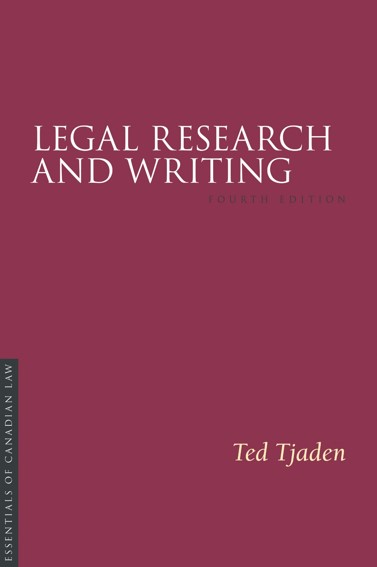
Legal
Research and Writing:
4th Edition
by Ted Tjaden
Softcover 512
pgs
Published: January 2016
ISBNs:
Paperback: 978-1-55221-414-5
e-book: 978-1-55221-415-2