Legal Research and Writing: Ted Tjaden
Home
Books
Law Journals
CLE Papers
Encyclopedias
Case Digests
Reference Tools
Law Blogs | News
Case Law | Court
Dockets
Legislation
International
Law
Foreign Law
Governments
Organizations
Knowledge
Management
Legal
Research and AI
Legal Writing
Legal Citation
Teaching LRW
Law-Related Movies
Law-Related Movies — Top 10
Movies - Home Page
"A to Z" List of Law-Related Movies
Movies Organized by Substantive Law Subject
Comedies
Court Martial Movies
Courtroom Dramas
Documentaries
Inspirational Lawyer Movies
Prison-Related Movies
Top 10
Set out below are the top 10 movies from my "A to Z" list, as chosen by me:
The Castle (1997). Starring Michael Caton. An extremely hilarious Australian comedy dealing with, of all things, expropriation (hence the title, which stems from the saying "A man's home is his castle"). Some hilarious courtroom scenes. Laugh-out-loud funny. See Roger Ebert's review (3 out of 4 stars).
A Fish Called Wanda (1998). Starring John Cleese, Kevin Kline, Eric Idle and Jamie Lee Curtis. A hilarious movie in which John Cleese plays a barrister who gets tangled up with a group of bungling diamond thieves. Extremely funny. Only marginally law related but the funny scenes with Cleese getting caught dancing in the buff are worth it. Read Roger Ebert's review (4 out of 4 stars).
Gandhi (1982). Starring Ben Kingsley and a cast of thousands. Directed by Richard Attenborough. An epic story of the life of Mahatma Gandhi who started as a lawyer in South Africa and who end up liberating India from British domination through his policies of non-violence. Read Roger Ebert's 4 of 4 stars review here.
Let Him Have It (1991). Based on a true story in the early 1950's in England where two young men are tried for and found guilty of the murder of a policeman. One of the young men avoids the death penalty because of his age but the other is hanged, despite his having the mental capacity of a young child. Gripping courtroom scenes (based on actual transcripts). An excellent movie. Read Roger Ebert's review (3.5 out of 4 stars).
Loving (2016). Starring Ruth Negga and Joel Edgerton, directed by Jeff Nichols. A well-done fictional recounting of the true life courtroom battle of Richard and Mildred Loving, an inter-racial married couple who successfully challenged Virginia state law prohibiting interacial marriage in the US Supreme Court decision in 1967 in Loving v Virginia. Read the positive review of The New York Times.
Making a Murderer (2015, 2018). This 10-episode documentary with a 10-episode second season released in 2018 (and both available on Netflix Canada), tells the story of Steven Avery, and his fight within the Wisconsin judicial system regarding his wrongful conviction for rape and his fight with the police officers who put in him jail (note: this summary is brief to avoid including spoiler alerts). A compelling story.
The Paper Chase (1973). Starring Timothy Bottoms, Lindsay "The Bionic Woman" Wagner and John Houseman as Professor Kingsfield. The now classic "must see" movie for law students about the struggles of a first-year law student and the battles he faces with his contracts professor (especially after he finds out he has been dating his daughter). Now somewhat dated, it is still a lot of fun to watch. Note the scenes with the law librarian. Parts of the movie were filmed in Toronto. Houseman won the Academy Award for his performance. Read the original New York Times review here.
Rabbit-Proof Fence (2002). Directed by Phillip Noyce and stars Kenneth Branagh. Based on the true story of 3 aboriginal girls ("half-castes") taken from their Aboriginal mothers and placed in a government residential school to be "domesticated". The movie documents their attempts to return to their families across the Outback, following a rabbit-proof fence. Read Roger Ebert's review (3.5 out of 4 stars).
Rake (series) (2010-2018). Starring Richard Roxburgh. This hilarious drama/comedy follows the career of Sydney barrister Cleaver Greene (played by Richard Roxburgh) in court with senile judges and interfering politicians. Extremely funny with many interesting legal issues for his clients. Available on Netflix Canada.
To Kill a Mockingbird (1962). Starring Gregory Peck as Atticus Finch. A solid dramatization of Harper Lee's novel telling the story of Atticus Finch and his daughter Scout and how Atticus defends a black man wrongfully charged with rape in a racially-biased environment. Peck won the Best Actor Oscar. Read Roger Ebert's review here.
Last updated: January 2026 | Legal / Terms of Use | Ted Tjaden © 2010-2026
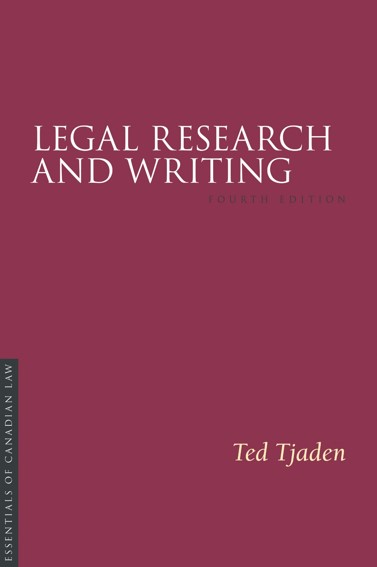
Legal
Research and Writing:
4th Edition
by Ted Tjaden
Softcover 512
pgs
Published: January 2016
ISBNs:
Paperback: 978-1-55221-414-5
e-book: 978-1-55221-415-2
Purchase here
_________________
Irwin Law: Canadian Online Legal Dictionary (click here)